
Home » Uncategorized (Page 10)
Category Archives: Uncategorized
Silence

Photo: Frektard
The new rudeness is silence.
I first became aware of this during the dot.com bust of 2000, when I was working as a marketing executive for an Internet software startup in San Francisco. This was one of those companies, still very much in evidence, that was run by men under thirty-years-old whose background was in the computer sciences and the Internet. They worked eighty-hour weeks regularly. Their favorite cuisine was cold pizza washed down with warm Coke, and they were barely capable of spoken language. They dressed like skateboarders.
Few had any manners. The founder and CEO of the company for which I was working — as a marketing executive responsible for selling the product to Fortune 500 companies — was a young German who had cut his business teeth in Silicon Valley, at one of the very large computer equipment companies. He had no personality, but he had invented what appeared to me to be a very good software product. The trouble was that his rudeness, characterized by his silence in response to the pesky questions of employees, and his silence during sales or marketing presentations to clients, added tremendous weight to the effort to sell the product. Marketing and sales, he sniffed — silently — were beneath him.
Many such have made millions in their start-up business endeavors, and I, who had devoted a career to working in corporations, was smitten with the idea of stock options and the probable millions that I would make too. So, putting my suits and neckties in the closet, I too took to Levis, although I drew the line at warm Coke.
I retained one other habit that I could not shake. I had good manners.
I always returned phone calls. I was considerate of my clients and their real wishes. I did not bully people in order to make the sale. When I emailed someone, I used full sentences, full words, full thoughts. Above all, when asked for an opinion, I gave it, expecting that, since my opinion was being sought, it would be considered.
But I often felt that my manners rendered me beneath contempt by those who ran this company. I was considered old-fashioned, too genteel for my own good, and not decisive enough. My manners were responded to with impatient silence, as though I would never, ever get to the point.
I left that company, the last I ever worked for, six months before it went under to the tune of sixteen million dollars in venture capital investment. The CEO left for New Zealand the day after the failure, I expect silently, and as far as I know has not visited the United States since.
Once I left business myself — in order to write full time — I figured that this new rudeness would also be left behind. But no. I’ve come to understand a subtle variant of the new rudeness, which is not based on the need for business dominance, but rather is being accepted in social circles as the new way of being polite.
Here are a few instances… You issue an invitation to friends to join you for a weekend in the mountains, and they simply don’t respond. You leave a voicemail asking someone to call you back, and he doesn’t. So you ask again, and he doesn’t, again. A long-term friend no longer returns your voicemails, and will give no explanation for why, other than a friendly avowal that there’s nothing wrong at all, followed by continuing long silence. Or your friends email you, inviting you for a weekend in the mountains, and you respond right away that you’d love to join them, “What can I bring?” etc., etc., and there is no more information offered. The invitation is forgotten or ignored by the people who issued it, and the matter is never brought up again.
It’s the worst when the silence is hidden behind a veil of smiling good will. You’ve called someone for an answer that you both realize you really need, to a question that you’ve left for that person in emails and voicemails many times, and when she picks up the phone, she regales you with patronizing good humor and the thought that you’ve been on her mind many times recently. Then, as a kindly afterthought, she hurries to the answer to your question. With regard to your many unanswered messages, there is only silence.
Everyone acts as though there never was such a relationship, never such invitations, never such questions. Silence reigns, the good manners that would enable a forthright conversation go out the window, and we arrive at the very summit of the new rudeness.
More silence.
No response is not enough. The 18th century British statesman Lord Chesterfield wrote that “manners must adorn knowledge, and smooth its way through the world.” I doubt that there are many in the United States now who would understand what Chesterfield was even talking about.
(This piece first appeared in the San Francisco Chronicle.)
Learning To Write About New York

Childe Hassam, “Allies Day 1917”
“Excuse me,” the man said. He stood across from me in an elevator of the building in which I was working, at 8th and 34th in Manhattan. “I think you are not American.”
His accent was Hispanic.
“How so?”
A large smile appeared. “For one, you say things like ‘Good morning’ and ‘How are you?'” I had seen him many times on the elevator in the few months since I had moved into my office, but we had not spoken.
“Aren’t you talking more about someone who isn’t from New York?” I said.
“Could be, and I am from Cuba.”
“Yes, and you say ‘Good morning’ now and then. I’ve heard it.”
“Occasionally, even though I’ve lived in New York almost all my life.”
“Well, you’re right,” I said. “I’m from California.”
“Ah, that explains it.” The man’s grin exposed many perfectly aligned teeth.
“Explains what?”
“Your seeming so foreign.”
I lived in Manhattan for two years during the late 1990s, and felt—the whole time—that I was little more than a tourist. I was aware of John Updike’s remark that “the true New Yorker secretly believes that people living anywhere else have to be, in some sense, kidding.” Now that I was living in New York, I understood how accurate his observation was. There is no town in the world like this one. Sure, San Francisco has its rattling cable cars and Golden Gate. Paris its Louvre and that famous revolution. London its now-sapped British empirical glory. Dublin its James Joyce. Istanbul the Straits of Bosporus.
But hey! None of those is New York.
I came back to San Francisco and sat on my experiences of New York for 10 years, thinking that surely I’d be kidding myself if I attempted to write anything about the place. To do so, I thought I would have to have lived there all my life. I worried that the city is too enormous and too varied to be understood by anyone, without his having walked its streets since birth. But then I learned that almost half of New York’s population was born not only somewhere else, but in a language other than English. Hundreds of places somewhere else. I figured, if they can live here and not be kidding, so could I… and moreover, I had the ability to describe the experience.
Almost all the stories I’ve written about New York feature characters who are from elsewhere, almost all of them speaking English as a second language. But as was the case when I lived in Manhattan, these people in my stories are citizens of New York City in essential ways, the fact of their exotic birthplace being one of the most important. The languages alone in New York City (perhaps every language in the world is spoken in those few square miles by somebody) exemplify its ethnic and cultural madness…a very good thing, in my view. Those of our citizens who decry ethnic diversity, and who grasp desperately at the idea that the United States is an English-speaking, Christian nation whose white people are its political and cultural arbiters, clearly have not enjoyed a couple days in Manhattan. Of course, with such ideas as theirs, those few days might be terrifying for them. But for those who realize that the United States is, as touted, a nation of immigrants from every continent, New York is the city where you can find the resultant burst of extraordinary world fruition.
Two books helped me immensely, although neither had much to do with flights of fictional fantasy in contemporary New York. Eric W. Sanderson’s Mannahatta: A Natural History of New York City contains everything you ever wanted to know about Manhattan as it was on September 12, 1609, the day that Henry Hudson dropped anchor off the island. The geological history of the island, how it once lay on the ocean floor, then was part of a vast mountain range, finally the sea-level vestige of that mountain range, and many other iterations along the way, are all included in this book. As well, the book tells how the verdant natural settings of the island have been changed by the influx of human beings since that day in 1609.
Gotham: A History of New York City to 1898 by Edwin G. Burroughs and Mike Wallace is THE history of what those humans did in New York up to the end of the 19th century. Overall it is my favorite book of history ever, and I had the pleasure of reading it while I was living in New York. That allowed me to go to places and surround myself in my imagination with occurrences that are so vividly portrayed in Gotham.
Both these volumes are fueled by the juggernauts of geology and history that made New York what it is today. For my fictional purposes, both presented the fluid, immense noise and excitement of New York, whether it be an island propelled by a tectonic plate into the east coast of what would become the American continent, or an explosively imagined settlement where much of the history of the American continent would be determined, written…and written about.
For a writer of fiction, one of the beauties of living in San Francisco, as I now do, is that San Francisco is a small, sophisticated city holding—barring the next earthquake—to the edge of the west coast. It has fine music, great opera, a ton of writers, wonderful art and terrific food. In my case, because of its relative quiet, it also provides a place of one’s own in which to think calmly about New York.
(Terence Clarke’s story collection New York will be published in book form next year. This piece first appeared in Huffington Post.)
Saddle Up! And Don’t Forget Your Hat.
Until recently, I never myself owned a cowboy hat. Then I met Jimmy Harrison.
I have envied many cowboy hats in my life. John Wayne’s, for instance, which is iconically famous, a big hat for a big man, its very wide brim reminding me of a ship’s wake making its way across a troubled sea. Clint Eastwood’s is not as grand, but it very much suggests the character that he plays in the spaghetti westerns of Sergio Leone. The hat is grizzled and slow to burn. It says little. Its crown resembles a dented tin can that its owner has carried around from one gunfight to the next.
Then there is Noah Beery Jr.’s. A lot of people may not remember him, a character actor who played in many westerns from the thirties to the fifties and went on to a career on television’s Rockford Files as James Garner’s father. He is one of my favorite screen cowpokes, principally because of his hat. It resembles a porkpie, its narrow brim rolled up all the way around. He wears the hat back on his head, a shock of hair coming out from beneath it to adorn his forehead. In Red River, one of John Wayne’s greatest films, Beery’s character, Buster McGee, is always identifiable because of this hat, which is totally unique among those of all the other cowboys in the movie. Even in the famous roundup scene that begins with the cowpunchers whooping it up individually, each one singled out by the camera through almost a dozen cameo close-ups, Beery’s is special because the hat makes him look like a little kid hurrying to play cowboy. He’s excited, happy and ready to ride.
Then, in the chaotic scene filled with long shots in which the cattle are, indeed, being rounded up by all the cowboys, you can identify Beery immediately because of his hat. Horses are flying around. Cattle are confused and afraid. Dust is everywhere. Beery on his horse battles all these elements, his hat consistently reminding you of exactly which cowpoke he is.
Jimmy Harrison is the founder and proprietor of Double H Custom Hat Company
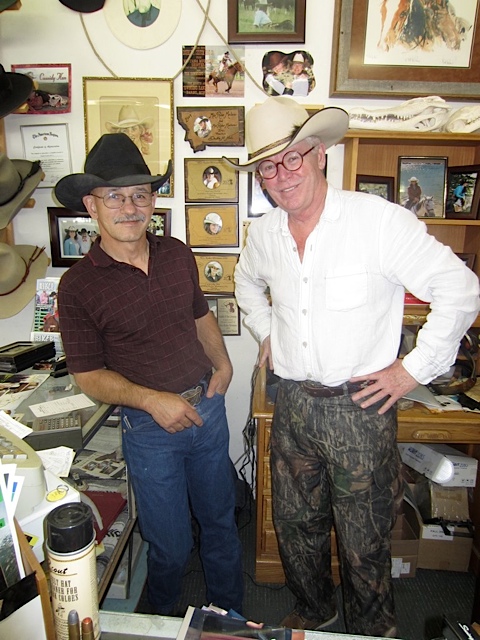
Jimmy Harrison (l.) and Terence Clarke.
Photo: Beatrice Bowles
in Darby, Montana, and among those who know their hats, he is a famous man. He has built hats — his phrase — for Dick Butkus, Willie Nelson, Garth Brooks, Emmylou Harris, chef Paul Prudhomme and former Mayor Willie Brown of San Francisco, among many thousands of other customers.
Jimmy operates out of his store in downtown Darby, a town of perhaps a thousand people at the southern end of Montana’s Bitterroot Valley. He builds several lines of hats that he displays in the shop, but his favorites—and his most popular—are those he custom builds for individual clients. The workroom behind his store is a place filled with hundreds of remnants of felt and leather, hand tools, work tables, hat forms, hand-made hat bands, photographs of Jimmy, his family, friends and customers, all in a seeming jumble of confusion. But it is also a place where careful thought, individual pride, precise handiwork, thoughtful design and only the best of materials come together in each individual hat. “I guarantee everything,” he says. “You can wear these hats forever.”
My fitting for a Double H hat took about twenty minutes. Jimmy sat me down on a stool in the shop and brought out a metal device that he fitted over my head. It was a kind of airy helmet. One circular piece of thin, pliant metal went around my head horizontally. It was connected to a few pieces of the same metal that fit over the top of my head, front to back and side to side. There were bolt-like adjusters that tightened or loosened the whole device as Jimmy set about figuring out the exact outside dimensions of my skull.
He took many notes. As he carefully adjusted the device, I felt that I was being examined by a nineteenth century physiognomist to determine the nature of my inner being, my character and the level of my intelligence. I also briefly felt as though I were being readied for the electric chair. But finally Jimmy was satisfied, and he told me there would be no problem building a hat that I would truly value. It came to my office in San Francisco about six weeks later, and fit perfectly.
Among hat makers, Jimmy is a purest. “I guarantee everything,” he says. “I put the ‘HH’ brand on every hat I make, and that means it’s the highest quality. The materials in my hats are simple. The prime quality is a 100 percent beaver felt, and I also make a less expensive model with a 50-50 mixture of beaver and rabbit felt.” He removes his own, a black cowboy hat that appears to be in perfect shape, brand new. “This one’s 15 years old. 100 percent beaver. It still holds its shape perfectly. It blocks very well, and I wash it once a year. So it’s been washed 15 times.” He holds it out before him for inspection. It still looks pristine. “You’re not going to get a hat like this somewhere else.”
Making these hats is not Jimmy’s only talent. As a very young man, he rode steers and horses in the rodeo. This was tough duty. “It wasn’t the same then as it is now. Now you’ve got all this money and big prizes. When I was doing it, it was for the fun of it. The skill. You’d take a fall. You’d get back up. You know, I’d make a couple hundred dollars a year and think that was great.”
But there was a price to be paid. Once, while riding a bronco, Jimmy was thrown to the ground with such force that he broke his pelvis in several places. “Yeah, it had to be knitted back up again.” Jimmy took it pretty much in stride, but decided that another line of work was in order. “But there weren’t a lot of physical jobs I could do, and I really enjoy working with my hands.” Jimmy had already been learning about shaping hats, and he saw that he had a distinct talent for this sort of thing, “Building a hat appealed to me. It’s a tangible product, and you can see that you’ve done something.”
So he apprenticed himself to Sheila Kirkpatrick, a custom hat maker in Wisdom, Montana. He had known her for years, and had heard that she was going to sell her business. He asked if he could learn the basics from her, and with that he set about mastering the art. “And I’ve done pretty good,” Jimmy smiles.
Incidentally, Jimmy shrugs at the idea that rodeo was a very dangerous thing to be doing. “I worked as a cowboy for some years, too. And I think I probably got more injuries from that than from riding those broncos.”
“One of the hardest hats to make,” Jimmy says, “is an old beat up one. Someone will bring in his grandfather’s hat, that looks like it’s been out in the backyard in heavy weather for years. It’s got big stains. The brim is faded and it’s lost its shape. You know, it looks terrible. But the guy loves it because it was his grandfather’s. So he wants a new one just like it. In just as bad a condition, but a brand new one.” Jimmy shrugs. “That’s very hard to do.” He surveys his shop and all the examples of his artisan craftsmanship. “But that’s part of the game. That’s what they want.”
For Jimmy, the customer is king. “If I make a hat that suits you, it will become part of you. I’ve had people come into the store and the fellow will buy a cowboy hat for his wife, custom-designed, custom-fitted. And when she gets it, she’ll say ‘This is so beautiful, I want to hang it on a wall.’ But you know, a year later, they’ll come back in, and she’ll have the hat on, and her husband will tell me ‘Jimmy, she wears that hat everywhere she goes.'”
He looks around the shop, at the shelves and racks that hold the myriad non-custom hats he has built (nonetheless by hand, nonetheless of top quality) and nods. His own black hat adds unmistakable cachet to the gesture. “My favorite customer? Someone who’s gonna appreciate it. And above all, no one that leaves here with one of my hats is gonna look silly. I make the top quality hat, and people like the fact that I can give them one.”
Terence Clarke’s new novel The Notorious Dream of Jesús Lázaro will be published later this year. This piece appeared originally in Huffington Post.
 Terence Clarke