
Home » Writing (Page 2)
Category Archives: Writing
OMG!@e-speak

Johannes Vermeer: Lady Writing A Letter With Her Maid
In the history of literature, the genre of the letter has been a very important element. Epistolary exchange has shed light on the lives of most of the important artists and historical figures — and some less important figures that happened to have written well — in the history of the world.
This light has revealed profound emotional difficulty and expressions of love… savored love, questioned love and destroyed love. Letters often exposed the high comedy of family disputes. The horrors of war were made memorable in letters from the front, while the onerous effects of preposterous government or church intrusion on the sensuous spirit were brought into the open. The letter, as a form, shed clear light on just about everything.
Now we have email. When I first encountered this phenomenon several years ago, I was heartened. With the birth of the telephone and, much later, the television, good personal writing had abruptly disappeared. It was easier to pick up the phone and call. It was more fulfilling to watch a game show than to write to your lover. So, most people gave up writing letters, and an entire literary genre almost ceased to exist.
Email held out the possibility for a resurgence of the letter-form through use of the Internet. Perhaps now people would write to one another again, a consummation devoutly to be wished. The letter is so important to the history of human affairs that its disappearance was like the withering away of a human organ, one that spirits the blood and makes it flow. Email would restore that organ, I hoped.
It has become apparent, though, that email has not risen to the challenge.
Letters hold together. Emails often have nothing to grab on to. Letters call for contemplation and soulful enjoyment. Emails call for very little. Letters contain cries for understanding, personal descriptions of terrible events or recoveries of soul. Emails tap-tap-tap across a depthless surface, asking only that they not be ignored, which they so often are. Letters contain a beginning, a middle and an end. Emails are dull wisps of nothing, written in as few characters as possible. It is this kind of artless dodging of anything important that is the norm in email and in its little brother, texting. And texting’s little brother, the tweet, is now the perfect email.
So my wish for the return of real writing has not been fulfilled. This is due to something I had not foreseen at all, which is that although the usual emailer may want exchange of some kind (perhaps a revised bill of lading, a recipe for goulash or Miley Cyrus’s URL), an email generally is not exchange. It almost never cares for good writing. The email is a depthless, short, ungrammatical demand. There are slightly meaningful emails, to be sure, like those that talk about one’s cat or how to screw in a light bulb. But even emails like these are random momentary conversations that go nowhere, or at least not far.
And now, horror of horrors, we have the Twitter novel, which somehow I feel is not destined — at least yet — to deny Dickens and all those others their insurmountable place in the pantheon. But it might. We will have seen the end of human transcendence on this planet when a chapter like number 42 in Moby Dick, on the whiteness of the whale, which is surely one of the most lyric and strange pieces of writing in the English language, is replaced by a chapter of 140 characters that have little to do with each other, as is the case with most tweets.
So, for the vast majority of this new language I propose the term “@e-speak.” The word could be an adjective, a kind of descriptive term that refers simply to the nature of the email/tweet itself. For example, you read a short little tweet, of a few impenetrable words and signs, with no capital letters and no punctuation, something about nothing written in illiterate language. It rattles with @e-speak inconsequence. That’s an adjective.
My use of the term would also make it into a noun. @e-speak is the language that, in another context, would be called gibberish. OMG!
Terence Clarke’s New York story “Everyone in L.A.” is available at Amazon.com. Visit him on Twitter…
Learning To Write About New York

Childe Hassam, “Allies Day 1917”
“Excuse me,” the man said. He stood across from me in an elevator of the building in which I was working, at 8th and 34th in Manhattan. “I think you are not American.”
His accent was Hispanic.
“How so?”
A large smile appeared. “For one, you say things like ‘Good morning’ and ‘How are you?'” I had seen him many times on the elevator in the few months since I had moved into my office, but we had not spoken.
“Aren’t you talking more about someone who isn’t from New York?” I said.
“Could be, and I am from Cuba.”
“Yes, and you say ‘Good morning’ now and then. I’ve heard it.”
“Occasionally, even though I’ve lived in New York almost all my life.”
“Well, you’re right,” I said. “I’m from California.”
“Ah, that explains it.” The man’s grin exposed many perfectly aligned teeth.
“Explains what?”
“Your seeming so foreign.”
I lived in Manhattan for two years during the late 1990s, and felt—the whole time—that I was little more than a tourist. I was aware of John Updike’s remark that “the true New Yorker secretly believes that people living anywhere else have to be, in some sense, kidding.” Now that I was living in New York, I understood how accurate his observation was. There is no town in the world like this one. Sure, San Francisco has its rattling cable cars and Golden Gate. Paris its Louvre and that famous revolution. London its now-sapped British empirical glory. Dublin its James Joyce. Istanbul the Straits of Bosporus.
But hey! None of those is New York.
I came back to San Francisco and sat on my experiences of New York for 10 years, thinking that surely I’d be kidding myself if I attempted to write anything about the place. To do so, I thought I would have to have lived there all my life. I worried that the city is too enormous and too varied to be understood by anyone, without his having walked its streets since birth. But then I learned that almost half of New York’s population was born not only somewhere else, but in a language other than English. Hundreds of places somewhere else. I figured, if they can live here and not be kidding, so could I… and moreover, I had the ability to describe the experience.
Almost all the stories I’ve written about New York feature characters who are from elsewhere, almost all of them speaking English as a second language. But as was the case when I lived in Manhattan, these people in my stories are citizens of New York City in essential ways, the fact of their exotic birthplace being one of the most important. The languages alone in New York City (perhaps every language in the world is spoken in those few square miles by somebody) exemplify its ethnic and cultural madness…a very good thing, in my view. Those of our citizens who decry ethnic diversity, and who grasp desperately at the idea that the United States is an English-speaking, Christian nation whose white people are its political and cultural arbiters, clearly have not enjoyed a couple days in Manhattan. Of course, with such ideas as theirs, those few days might be terrifying for them. But for those who realize that the United States is, as touted, a nation of immigrants from every continent, New York is the city where you can find the resultant burst of extraordinary world fruition.
Two books helped me immensely, although neither had much to do with flights of fictional fantasy in contemporary New York. Eric W. Sanderson’s Mannahatta: A Natural History of New York City contains everything you ever wanted to know about Manhattan as it was on September 12, 1609, the day that Henry Hudson dropped anchor off the island. The geological history of the island, how it once lay on the ocean floor, then was part of a vast mountain range, finally the sea-level vestige of that mountain range, and many other iterations along the way, are all included in this book. As well, the book tells how the verdant natural settings of the island have been changed by the influx of human beings since that day in 1609.
Gotham: A History of New York City to 1898 by Edwin G. Burroughs and Mike Wallace is THE history of what those humans did in New York up to the end of the 19th century. Overall it is my favorite book of history ever, and I had the pleasure of reading it while I was living in New York. That allowed me to go to places and surround myself in my imagination with occurrences that are so vividly portrayed in Gotham.
Both these volumes are fueled by the juggernauts of geology and history that made New York what it is today. For my fictional purposes, both presented the fluid, immense noise and excitement of New York, whether it be an island propelled by a tectonic plate into the east coast of what would become the American continent, or an explosively imagined settlement where much of the history of the American continent would be determined, written…and written about.
For a writer of fiction, one of the beauties of living in San Francisco, as I now do, is that San Francisco is a small, sophisticated city holding—barring the next earthquake—to the edge of the west coast. It has fine music, great opera, a ton of writers, wonderful art and terrific food. In my case, because of its relative quiet, it also provides a place of one’s own in which to think calmly about New York.
(Terence Clarke’s story collection New York will be published in book form next year. This piece first appeared in Huffington Post.)
How’s That Novel of Yours Doing?
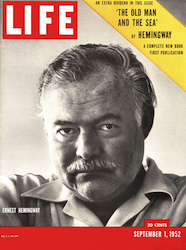 The wish for fame, so illusory a thing, can kill you. Or at least, it can kill your novel.
In an essay in The Spectator in 1711, Sir Richard Steele wrote that it is “the worst way in the world to Fame, to be too anxious about it.” For almost all of us who took up writing in order to be like Ernest Hemingway, this is good advice. The Hemingway goal hasn’t worked in my case or, I suspect, in that of most others who have had so markedly specific an intention. Perhaps all others. This is so because such a goal has nothing to do with writing well. It has an awful lot to do with churlish envy, as well as what we know about Hemingway, that he marketed himself almost from the beginning in order to get where he got.
Perhaps his remarkable fame derives from the great interest there has always been in his adventurous life. But I think his adventures had little to do with his ability to write well, as he so often did. In his writing, he sought to please his one greatest fan, which was himself, and for this steadfastness he deserves the congratulation he gets.
When I began writing seriously, I had the theory that writing fiction was a public, not a private, endeavor. Because it is so intense a form of communication, it seemed foolish to me to write without the idea of getting published. Publishing with an established firm, either major or minor, was then the only way of getting your work in front of a public. So, without publishing, there was no communication, and without a public, writing to me wasn’t worth doing.
But then, as now, there was a gauntlet that writers had to run, to get to the golden moment of publication by a major U.S. publisher. Like a great moat surrounding an obdurately faceless castle, the army of literary agents floats about, thick with weeds and goo. Any writer who has spent time in these waters has a library of favorite phrases that he or she has learned from agents. “Your work has significant integrity, but needs to be fleshed out a bit more.” “Though excellent, it’s just not right for us at this time.” “You’re clearly a writer with great promise, and we wish you the best in your search for representation elsewhere.” “Couldn’t possibly sell this in today’s difficult market.” And many more.
The single best one my work ever evoked came from an agent employed by a West Coast firm, both now very long gone. The entirety of his communication to me read, “Wooden, foolish, a little bit trite… But, thanks!”
Until the advent of self-publication on the internet, two-thirds of the manuscripts published in the United States in any given year by major companies were represented by literary agents, and to this day, when you look at the submissions guidelines for most major publishers, they say that they will not consider “unagented” work. So that seems pretty open and shut. If you want to publish with one of the Big Six, you need an agent. Thus you go swimming — because you must — in the moat, an experience that, if you do not have a ribald, very well oiled sense of confident humor, will drive you nuts.
Dealing with the major publishers themselves — should you survive the moat — is much easier because you have a goal, they are demonstrably interested and they know who you are. It’s just you and your editor, and you have a common wish.
There is a second problem with the Hemingway ideal, a problem spelled out succinctly by Richard Steele. If you write to be famous, the quality of your work will almost certainly be damaged by the anxiety with which you’re writing. You have the memory of all those great books, written by writers you admire tremendously, and there comes the time, often, when you worry that what you do will never come up to the level of what they did. You finish writing a paragraph or two, then you recall Joseph Conrad writing about something similar, or Joyce or Greene or Ellison or Dickens or Austen, Eliot, Nabakov, Baldwin, Faulkner… You stop writing. Or you continue on, the shades of all these others standing behind you, dark, celebrated, bookish shades brimming with talent, writers now long dead except for their great fame. You sense them watching what you’re doing.
It doesn’t work, and you won’t make it.
When I finally understood this and backed off, my writing improved and I started getting published. Right away. It was a simple, one-to-one relationship. Now I pay occasional attention to the idea of fame, when I’m reading about Lady Gaga or some such. But I never allow such a thing to affect what I’m doing. Fame is something others bestow upon you. Good writing is what you bestow upon yourself, your own most faithful, loving, and observant fan. If you don’t write for the emotional benefit of that reader, I believe your chances for fame will vanish.
 Terence Clarke